BJJ injuries by the numbers, and how to keep your game while you heal
Train long enough and you will get hurt. The studies agree on roughly how often, where and when. They also point to a risk that gets less attention than the injury itself: the time away.
How often
A 2025 survey asked 881 practitioners around the world, all training at least once a week, about the previous twelve months. It counted 5.5 injuries per 1,000 hours of training and 55.9 per 1,000 competition matches, and the rate rose with belt rank.1 Another survey, of 1,140 athletes in 62 countries, found that two in three had been hurt badly enough to miss at least two weeks in the past three years.2
At three hours a week, 5.5 per 1,000 hours works out to about one injury every 14 months. That is arithmetic on an average, not a forecast for anyone, but it explains why most people who train for years have a story.
| Training for | Injured | Answered |
|---|---|---|
| Less than 1 year | 7.0% | 329 |
| 1 to 2 years | 17.0% | 371 |
| 2 to 4 years | 26.7% | 442 |
| 4 to 7 years | 42.7% | 335 |
| 7 to 10 years | 51.5% | 169 |
| 10 to 15 years | 52.3% | 155 |
| 15 years or more | 59.0% | 144 |
Gold BJJ’s State of Jiu Jitsu survey: 1,945 answers with usable years of training. What counted as serious was left to each person. Our calculation.
The same pattern shows in Gold BJJ’s survey of 1,948 practitioners: the longer people had trained, the more of them reported a serious injury, from 7% in the first year to 59% after fifteen.3,4
Where and when
- Knees, then shoulders. Knees were 25% of the injuries in the 881-person survey, shoulders 13%.1 In the 1,140-person survey the knee led too, at 27%, mostly meniscus and ligament tears.2
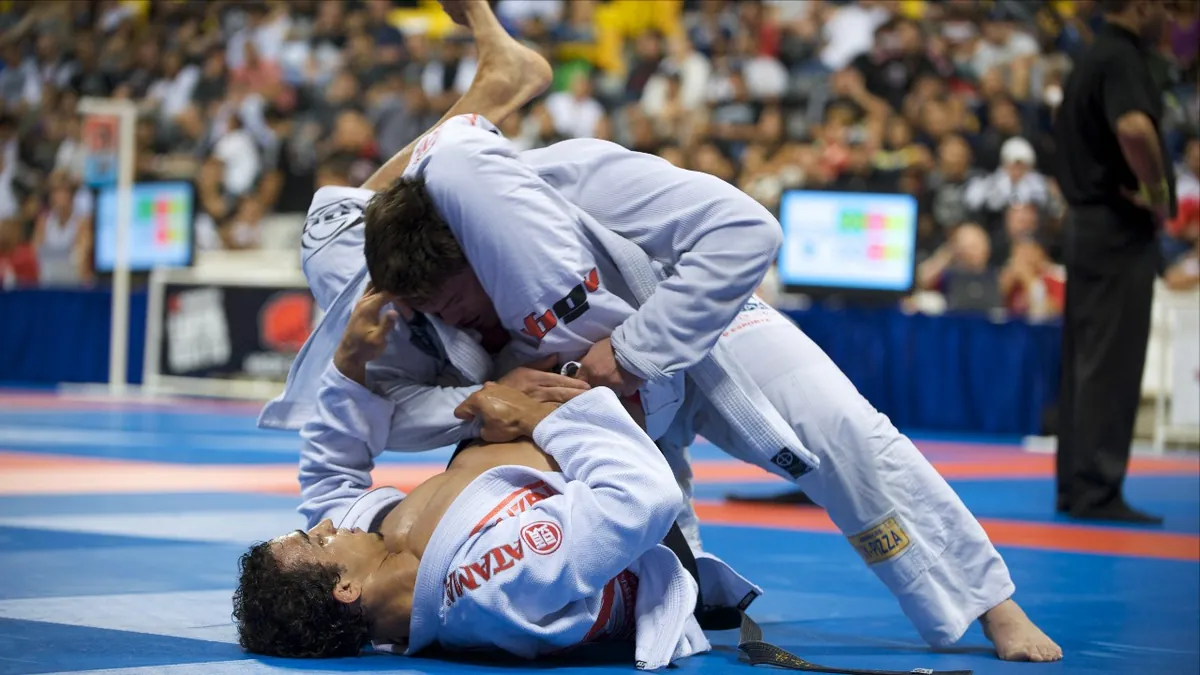
- In sparring. In the first survey, 79% of training injuries happened while sparring; in the second, 78% of all injuries did. Submissions caused 30% and takedowns 26%.1,2
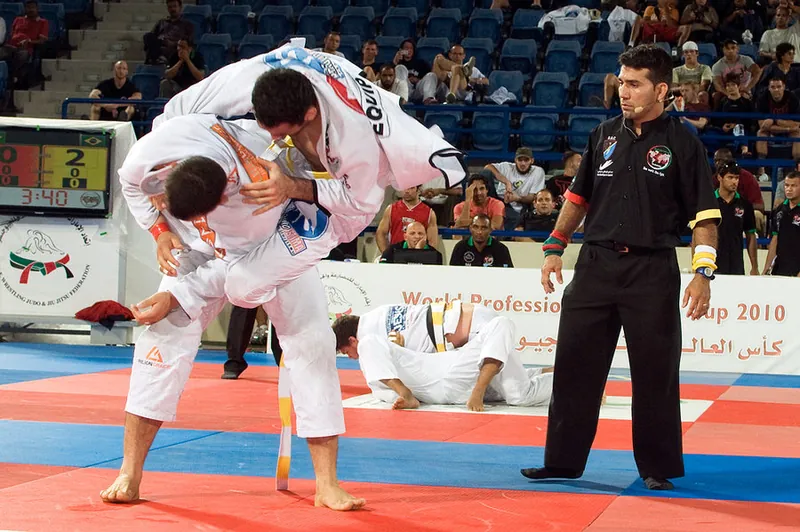
- Elbows in competition. At eight tournaments in Hawaii, injuries came to 9.2 per 1,000 match appearances. The elbow was the joint most often hurt, and the armbar the most common cause. That was lower than published rates for judo, taekwondo, wrestling and MMA.5
More visits to the ER, not proof of more risk
BJJ-related visits to US emergency departments grew nearly fivefold from 2015 to 2024, while visits for martial arts overall held steady: BJJ’s share of them rose from 7.3% to 27.7%. Sprains and strains led, then fractures.6 The authors are careful about what that means. Without a count of how many people train, these are visits, not a measured change in each person’s risk.
The other risk: the layoff
At one club in Canada, 70 practitioners were asked about their injuries and whether they had thought about quitting. Those who needed more than four months off were 5.5 times more likely to have considered quitting, and those who needed surgery 6.5 times more likely.7 It is one small club, and considering quitting is not quitting. But it names a real cost: the longer the time away, the harder the way back.
What you can still train
A layoff does not have to be a blank. In one experiment, healthy adults had a wrist and hand immobilised for four weeks. Those who were only immobilised lost 45% of their wrist strength. Those who also spent the four weeks imagining strong contractions, five days a week, lost 24%: about half as much.8 A 2025 review of 11 trials of mental imagery during immobilisation after surgery or injury found less pain, and promising effects on movement and strength, though the trials were small and at high risk of bias.9
Those studies measured strength and pain, not jiu-jitsu. For technique, the same idea is the one in Visualization in BJJ: what the science actually says: rehearse the moves you were working on in your head, step by step, at real speed. If your doctor agrees, keep going to class to watch, and write down what is taught, so that you do not come back starting from scratch.
What the studies do not show
All of these surveys rely on people remembering their injuries, and on the people who chose to answer. They define an injury differently: a week out in one, two weeks in another, and “serious” left to the respondent in Gold BJJ’s. None of them shows what prevents injuries in BJJ.
TakeawayExpect to get hurt at some point, most likely while sparring, most often a knee or a shoulder. When it happens, the injury is not the only thing to manage: the months away are a risk of their own. Keep the game alive in your head while your body heals.
Cauli is built for the days you cannot roll as much as for the days you can. The techniques you wrote stay in your journal as steps, and a two-minute rehearsal from the couch asks you to recall each one before it shows it. It is not medical advice, and it does not replace your doctor or your coach. We have not run a study on Cauli itself.
Sources
- Stegerhoek, P. M., Brajovic, B., Kuijer, P., & Mehrab, M. (2025). Injury prevalence among Brazilian Jiu-Jitsu practitioners globally: a cross-sectional study in 881 participants. BMJ Open Sport & Exercise Medicine, 11(1), e002322. doi.org/10.1136/bmjsem-2024-002322
- Hinz, M., Kleim, B. D., Berthold, D. P., et al. (2021). Injury patterns, risk factors, and return to sport in Brazilian jiu jitsu: a cross-sectional survey of 1140 athletes. Orthopaedic Journal of Sports Medicine, 9(12), 23259671211062568. doi.org/10.1177/23259671211062568
- Gold BJJ. “BJJ Statistics: Jiu Jitsu by the Numbers.” Results of its State of Jiu Jitsu survey, run in late 2024 and early 2025. goldbjj.com/blogs/roll/statistics
- Gold BJJ. 2024 State of Jiu Jitsu Survey Results, anonymized: 1,948 answers (CSV). The shares by years of training are our own calculation. cdn.shopify.com/s/files/1/1820/5765/files/2024_State_of_Jiu_Jitsu_Survey_Results_-_Anonymized.csv?v=1742923486
- Scoggin, J. F., 3rd, Brusovanik, G., Izuka, B. H., et al. (2014). Assessment of injuries during Brazilian jiu-jitsu competition. Orthopaedic Journal of Sports Medicine, 2(2), 2325967114522184. doi.org/10.1177/2325967114522184
- Gamadia, M., Middleton, C. J., Thatcher, M., et al. (2026). Increasing emergency department burden of Brazilian jiu-jitsu injuries: a national 10-year analysis of mechanisms and severity predictors, 2015–2024. Orthopaedic Journal of Sports Medicine, 14(10). doi.org/10.1177/23259671261486951
- Petrisor, B. A., Del Fabbro, G., Madden, K., et al. (2019). Injury in Brazilian jiu-jitsu training. Sports Health, 11(5), 432–439. doi.org/10.1177/1941738119849112
- Clark, B. C., Mahato, N. K., Nakazawa, M., Law, T. D., & Thomas, J. S. (2014). The power of the mind: the cortex as a critical determinant of muscle strength/weakness. Journal of Neurophysiology, 112(12), 3219–3226. doi.org/10.1152/jn.00386.2014
- Campos-Fernández, C., Hernandez-Lucas, P., & de Oliveira, I. M. (2025). The effect of mental imagery applied during a post-surgical or post-traumatic immobilization period: a systematic review and meta-analysis. Panminerva Medica, 67(4), 236–244. doi.org/10.23736/S0031-0808.25.05382-0