How to take BJJ notes you will actually use
A notebook that is written and never opened does very little. Research on note-taking has said so for decades. It also says what kind of note is worth writing, and what to do with it afterwards.
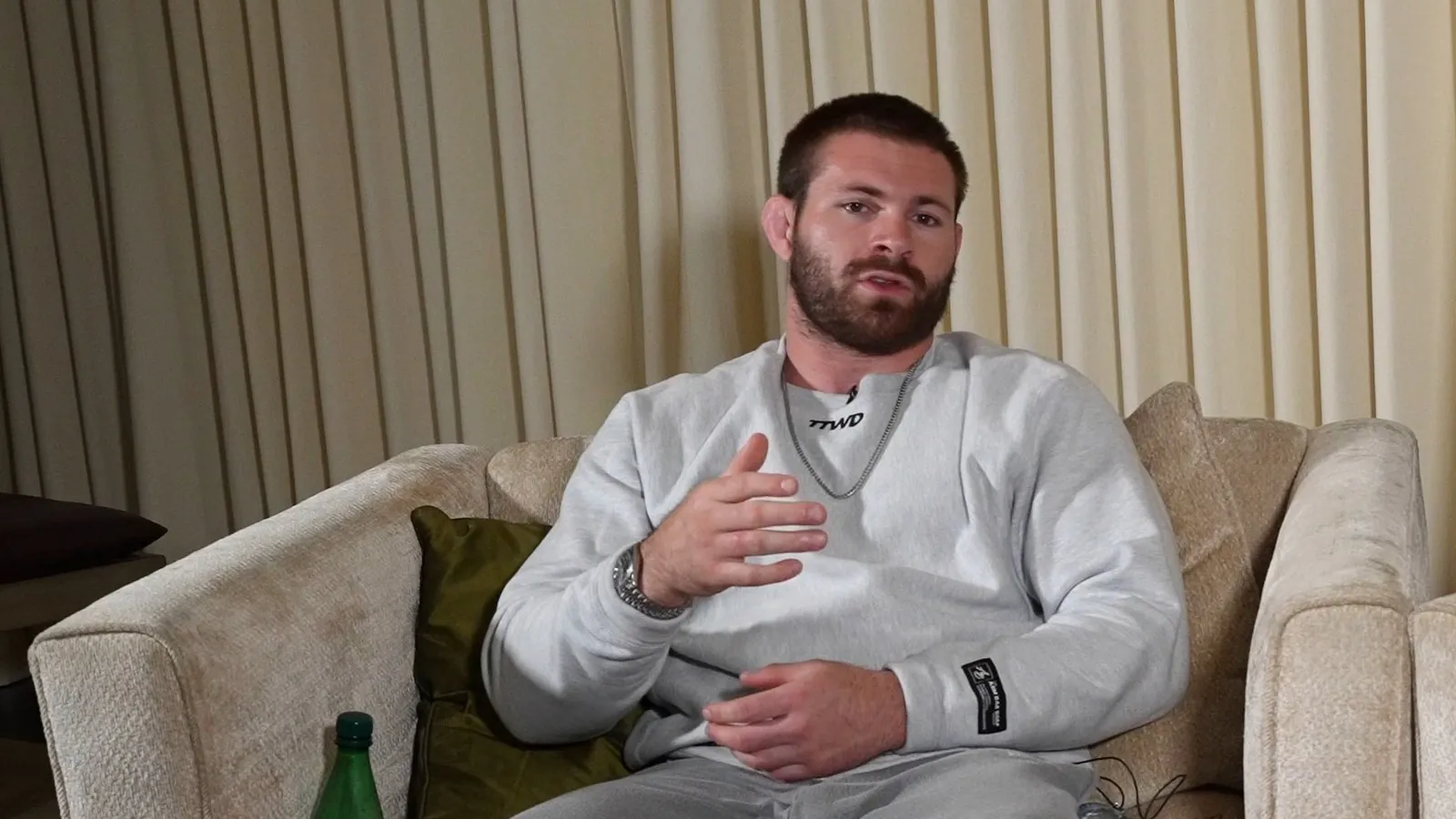
Kenny Florian once asked Rafael Mendes, a black-belt world champion, how much note-taking he does.
“I don’t just take notes of things that I was doing wrong, but I also like to write down everything that’s working right.”
He goes on: “So I have my notebook and everything is in there.”1
Writing helps a little. Using the notes helps a lot.
Studies of note-taking separate two things: the act of writing, and what you do with the notes later. A meta-analysis of 57 studies found that writing notes, with no review, has a positive but modest effect on learning.2 A second, of 33 studies, found that taking notes and reviewing them has a substantial one.3
Those were students in classrooms, not grapplers. But the split is the useful part. The notebook is not the training. Coming back to it is.
Why not just film it?
Film it too. A video keeps the technique, but it does not put it in your head. In six experiments with 2,225 people, the more often people watched a skill, the more sure they were that they could do it, with no gain in what they could actually do.4 Jozef Chen, talking about how he studies instructionals, said the same in his own way:
“I would make sure to write it down just so I could recall it as I was training. So I wouldn’t just watch it and leave it at that.”
How to write a technique
- In your own words. Across 86 studies, people remembered what they had produced themselves better than the same material when they only read it.6 Do not copy the coach’s phrasing or the instructional’s. Write what you did.
- As steps, in order. Roger Gracie, on his cross-collar choke: “Every step of the movement, it’s important and precise. So, you know, you miss one detail on the way, you collapse.”7 A numbered list shows you the step you cannot fill in while you can still ask your coach.
- The same day. Forgetting is fastest at the start. In Ebbinghaus’s classic experiment, relearning a list took 58% less time after 20 minutes, and only 34% less after a day.8 That was nonsense syllables, not techniques, but the direction is not in doubt. How to remember BJJ techniques after class has the whole curve.
- What worked, too. This is Mendes’s point. A sweep that worked once and was never written down is hard to find again.
What goes in the note
- The name, the way your gym says it.
- Where it starts: the position and the grips.
- The steps, numbered, one action each. Three to six is plenty.
- The detail that made it work today.
- Where it failed, if it did.
For example, a Butterfly hook sweep:
- Sit up chest to chest, both hooks inside their thighs.
- Win the underhook. Control the far sleeve.
- Fall to my shoulder to load them onto my hip.
- Lift with the hook and follow them up to the top.
Then close the notebook
Most students say they study by rereading. A review of ten study techniques rated rereading low and practice testing high.9 In one experiment, students who read a text four times remembered 40% of it a week later. Students who read it once and recalled it three times remembered 61%.10
So do not read the note. Cover the steps, recall each one in order, then look. And come back at growing gaps, not all in one evening: a review of 317 experiments found that the longer you want to remember something, the longer the best gap between reviews is.11
What notes will not do
We found no study of note-taking in jiu-jitsu. The research here comes from classrooms and laboratories, and it tested memory for texts and words. Notes will not replace drilling or rounds. They keep what you learned long enough for you to drill it again.
TakeawayWrite the technique the same day, in your own words, as numbered steps, including what worked. Then use the note to test yourself, not to reread.
That is why Cauli is not another BJJ journal. It keeps the note, and then it asks for it back. In a rehearsal each step stays hidden until you have recalled it, and you grade the technique Solid or Shaky. Solid moves it up a ladder of 1, 3, 7, 14, 30 and 60 days, and Shaky moves it down. We have not run a study on Cauli itself. The method is the one in this article.
Sources
- Art of Jiu Jitsu (2016). “Inside The Mind” of Rafael Mendes, interview by Kenny Florian. Video; the quote is at 8:12. youtube.com/watch?v=kByimXb7SiA&t=492s
- Kobayashi, K. (2005). What limits the encoding effect of note-taking? A meta-analytic examination. Contemporary Educational Psychology, 30(2), 242–262. doi.org/10.1016/j.cedpsych.2004.10.001
- Kobayashi, K. (2006). Combined effects of note-taking/-reviewing on learning and the enhancement through interventions: a meta-analytic review. Educational Psychology, 26(3), 459–477. doi.org/10.1080/01443410500342070
- Kardas, M., & O’Brien, E. (2018). Easier seen than done: merely watching others perform can foster an illusion of skill acquisition. Psychological Science, 29(4), 521–536. doi.org/10.1177/0956797617740646
- The Sonny Brown Breakdown (2022). “Rapid Learning From BJJ Instructionals With Jozef Chen.” Video; the quote is at 12:37. youtube.com/watch?v=KSbinMafisM&t=757s
- Bertsch, S., Pesta, B. J., Wiscott, R., & McDaniel, M. A. (2007). The generation effect: a meta-analytic review. Memory & Cognition, 35(2), 201–210. doi.org/10.3758/BF03193441
- Lex Fridman Podcast #343 (2022). “Roger Gracie: Greatest Jiu Jitsu Competitor of All Time.” Video; the quote is at 1:14:03. youtube.com/watch?v=FhfmGM6hswI&t=4443s
- Murre, J. M. J., & Dros, J. (2015). Replication and analysis of Ebbinghaus’ forgetting curve. PLoS ONE, 10(7), e0120644. Ebbinghaus’s own figures are in its Table 3. doi.org/10.1371/journal.pone.0120644
- Dunlosky, J., Rawson, K. A., Marsh, E. J., Nathan, M. J., & Willingham, D. T. (2013). Improving students’ learning with effective learning techniques. Psychological Science in the Public Interest, 14(1), 4–58. doi.org/10.1177/1529100612453266
- Roediger, H. L., & Karpicke, J. D. (2006). Test-enhanced learning: taking memory tests improves long-term retention. Psychological Science, 17(3), 249–255. The figures here are from Experiment 2. doi.org/10.1111/j.1467-9280.2006.01693.x
- Cepeda, N. J., Pashler, H., Vul, E., Wixted, J. T., & Rohrer, D. (2006). Distributed practice in verbal recall tasks: a review and quantitative synthesis. Psychological Bulletin, 132(3), 354–380. doi.org/10.1037/0033-2909.132.3.354