Visualization in BJJ: what the science actually says
You can get better at jiu-jitsu off the mat. Not instead of the mat, but between sessions, in your head. The research on this is older and more solid than most people think.
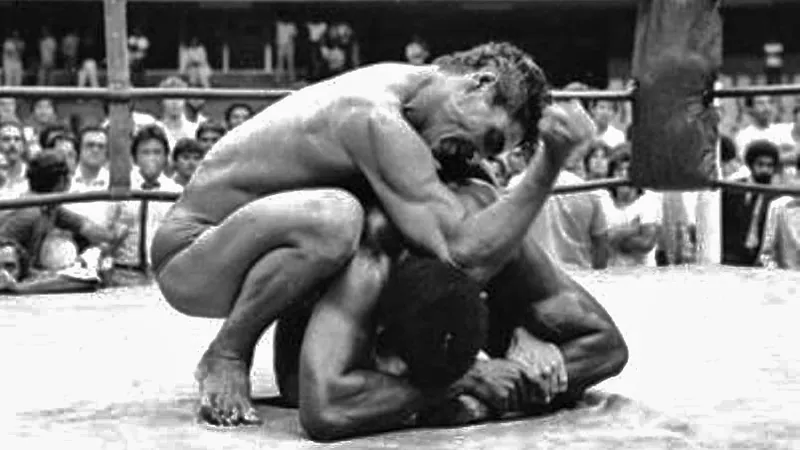
Rickson Gracie, asked about his last fight, against Masakatsu Funaki in 2000, put his calm down to three things:
“I could control my personal panic, my discomfort in my situation — kept managing everything through breathing, through calmness, through good visualization.”
In the same interview he says the lesson from an earlier fight stayed with him “in my daily visualizations.” For him it was a training habit, not a pre-fight trick.
Your brain rehearses on much of the same wiring
When you imagine a movement, your motor system runs a quiet simulation of it.2 Brain-imaging meta-analyses covering hundreds of experiments find that imagery recruits a large network that overlaps with the one used for real movement.3,4
The overlap is partial, not total. The primary motor cortex, which drives the muscles, is not consistently active during imagery. That is one reason imagining is not the same as doing.
It changes real performance
- Skill. In a classic study, people learned a five-finger piano exercise, two hours a day for 5 days, either by playing it or only by imagining it.5 The imagery group improved, though less than the group that played. Then, after a single 2-hour physical session, it matched the level the other group had reached after 10 hours.6
- Strength. After four weeks of imagined finger contractions, finger strength rose 22%. Real contractions gave 30%, and the untrained group 3.7%.7
- Sport. Across sport studies, imagery interventions had a medium effect, and imagery added to physical practice beat physical practice alone.8 A 2020 replication of 37 newer studies found a smaller effect, but a real one.9
What it won’t do
It won’t replace rounds. Mental practice works, but physical practice works better, and the combination is the point.6,14 How much it helps also depends on the task and on how long ago you rehearsed, so it has to be repeated.10
And grappling-specific evidence is thin. A review of judo psychology found little data on imagery and judo performance.11 The principle transfers, but no one has proved how much it adds to your guard passing.
How to rehearse a technique
- Pick one move you drilled this week. Imagery works on a pattern you are building, not on a video you half-watched.
- Make it real. First person, real speed, the grips, the weight, the moment it usually fails. The PETTLEP model used by sport psychologists says imagery should be as close to the real performance as you can make it.12
- Recall before you check. Say the next step before you look it up. Pulling a memory out strengthens it more than rereading does.13
- Short and often. In strength studies, the best results came from about 15 minutes, three times a week, for four weeks.14
TakeawayVisualization is a real rep that you can do anywhere. It won’t replace mat time, but it makes the mat time you do get count for more.
That is the idea behind Cauli’s rehearsal. You write a technique in your own words after class. Then the app hides each step, and you recall it before you reveal it. Shaky steps come back sooner and solid ones wait, so the moves you drilled on Tuesday are still there on Thursday.
Sources
- Rickson Gracie Academy. “Fighting blind: Rickson Gracie on his final bout (part 3).” Interview, academy.ricksongracie.com. academy.ricksongracie.com/en/posts/fighting-blind-rickson-gracie-on-his-final-bout-part-3
- Jeannerod, M. (2001). Neural simulation of action: a unifying mechanism for motor cognition. NeuroImage, 14(1), S103–S109. doi.org/10.1006/nimg.2001.0832
- Hétu, S., et al. (2013). The neural network of motor imagery: an ALE meta-analysis. Neuroscience & Biobehavioral Reviews, 37(5), 930–949. doi.org/10.1016/j.neubiorev.2013.03.017
- Hardwick, R. M., Caspers, S., Eickhoff, S. B., & Swinnen, S. P. (2018). Neural correlates of action: comparing meta-analyses of imagery, observation, and execution. Neuroscience & Biobehavioral Reviews, 94, 31–44. doi.org/10.1016/j.neubiorev.2018.08.003
- Pascual-Leone, A., et al. (1995). Modulation of muscle responses evoked by transcranial magnetic stimulation during the acquisition of new fine motor skills. Journal of Neurophysiology, 74(3), 1037–1045. doi.org/10.1152/jn.1995.74.3.1037
- Malouin, F., Jackson, P. L., & Richards, C. L. (2013). Towards the integration of mental practice in rehabilitation programs. A critical review. Frontiers in Human Neuroscience, 7, 576. doi.org/10.3389/fnhum.2013.00576
- Yue, G., & Cole, K. J. (1992). Strength increases from the motor program: comparison of training with maximal voluntary and imagined muscle contractions. Journal of Neurophysiology, 67(5), 1114–1123. doi.org/10.1152/jn.1992.67.5.1114
- Simonsmeier, B. A., Andronie, M., Buecker, S., & Frank, C. (2021). The effects of imagery interventions in sports: a meta-analysis. International Review of Sport and Exercise Psychology, 14(1), 186–207. doi.org/10.1080/1750984X.2020.1780627
- Toth, A. J., McNeill, E., Hayes, K., Moran, A. P., & Campbell, M. (2020). Does mental practice still enhance performance? A 24 year follow-up and meta-analytic replication and extension. Psychology of Sport and Exercise, 48, 101672. doi.org/10.1016/j.psychsport.2020.101672
- Driskell, J. E., Copper, C., & Moran, A. (1994). Does mental practice enhance performance? Journal of Applied Psychology, 79(4), 481–492. doi.org/10.1037/0021-9010.79.4.481
- Ziv, G., & Lidor, R. (2013). Psychological preparation of competitive judokas – a review. Journal of Sports Science & Medicine, 12(3), 371–380. pmc.ncbi.nlm.nih.gov/articles/PMC3772577
- Holmes, P. S., & Collins, D. J. (2001). The PETTLEP approach to motor imagery: a functional equivalence model for sport psychologists. Journal of Applied Sport Psychology, 13(1), 60–83. doi.org/10.1080/10413200109339004
- Roediger, H. L., & Karpicke, J. D. (2006). Test-enhanced learning: taking memory tests improves long-term retention. Psychological Science, 17(3), 249–255. doi.org/10.1111/j.1467-9280.2006.01693.x
- Paravlic, A. H., et al. (2018). Effects and dose–response relationships of motor imagery practice on strength development in healthy adult populations: a systematic review and meta-analysis. Sports Medicine, 48(5), 1165–1187. doi.org/10.1007/s40279-018-0874-8